

How to Work With a Designer (So You Actually Get What You Pictured)

By Crystal Ashley-Weekes | C. Ashley Design
After so many years in this industry, logos, signage, apparel decoration, embroidery, promotional products, you name it, I can tell you that the projects that go smoothly and the ones that turn into a headache almost never come down to talent. They come down to preparation.
A client who brings the right information up front almost always ends up happier with the result than one who "just wants something that pops." The good news is you don't need to become a designer to work well with one. You just need to know what to bring to the table.
What Helps Me Help You
Most clients aren't sure exactly what to hand a designer when they start a project, and that's completely okay. The more context you can share up front though, the better I can do my job without a lot of back and forth. You don't need to have all the answers, but if you can tell me who your customer is, where this design is going to live, and what a successful result looks like to you, we're already off to a great start.

A good brief doesn't need to be fancy. It just needs to answer:
What's this for? A new logo, a trade show booth, a run of staff polos, a product label?
Who's it for? Who's actually going to see this, and what do you want them to think or feel
What's the personality? Give me three to five words that describe your brand. Bold and modern? Warm and approachable? Rugged and outdoorsy?
Where will it live? Storefront sign, embroidered cap, social graphic, packaging. The destination changes the decisions I make.
What's off the table? Colours, phrases, symbols, or styles you already know you don't want.
What's the deadline, and what do you need at the end? A print-ready file is very different from a social media graphic.
If you don't have all the answers yet, that's fine. Tell me what you do know and we'll figure out the rest together. But the more of this you can bring me on day one, the less back and forth we need later.
Bring the Right Files, Not Just the Ones You Have Handy

This is where a lot of projects lose time, and it's rarely anyone's fault. Most business owners just don't know what a designer or print shop actually needs. A few things to have ready:
Your logo as a vector file if you have one (.AI, .EPS, or .SVG), not a JPG or PNG pulled from your website. A vector scales to a billboard or shrinks to a pen without going blurry. A screenshot of your logo can't do that, and it might cost you a rebuild fee if that's all you've got.
If you already have branding, the CMYK, RGB, or Pantone codes for your brand colours. "Our blue" isn't specific, it means something different on every screen and to every printer. A code means close to the same thing every time.
Any fonts you're licensed to use, especially if you paid for a premium typeface. I need the actual files and confirmation you're licensed to use them commercially, otherwise we may have to find a substitute.
Existing brand guidelines, even informal ones. Old designs that worked well, photos you love, a style you're chasing.
Production details, if this is heading to print or production. The more I know up front, the fewer surprises and change fees later.
None of this is me being particular for the sake of it. It's what keeps your project on time and on budget.
Agree on the Ground Rules Before We Start
This is the step people skip most often, and the one that prevents almost every misunderstanding. Before any design work begins, we should both be clear on:
How many revision rounds are included in the quote.
Turnaround time. How fast you'll get drafts back from me, and how fast I need feedback from you to keep things moving.
What counts as a bigger change. If you approve a concept built around a mountain icon and then decide two rounds later you'd prefer a wave, that's not a tweak. That's a new direction, and it's fair for it to cost more. This matters even more with embroidery, where a full redigitize isn't a five-minute fix.
Who has final sign-off. If more than one person needs to approve the work, decide that now, not after I've built three versions based on three different opinions.
Getting this in writing up front isn't about being formal for its own sake. It protects you from surprise costs and protects me from scope creep, and it means neither of us is guessing about what's fair.
Give Me Feedback About the Problem, Not the Fix
The single most useful thing you can do as a client is describe what isn't working and let me figure out how to fix it. When you jump straight to a solution, you're often solving the symptom instead of the actual issue, and closing the door on a better answer.
Instead of saying... | Try saying... | Why it works better |
"Make it pop." | "This feels a little quiet for a grand opening banner. Can we make the main message feel more energetic?" | Tells me the goal, not just a feeling. |
"I don't like this colour." | "This colour doesn't feel right for our brand. Can we look at something more muted?" | Tells me what's wrong and points me in a direction, without just saying change it. |
"Make the logo bigger." | "I'm worried people won't recognize us from across the parking lot." | Gives me the actual problem. I might solve it with size, contrast, or placement. |
"This looks weird." | "The layout feels hard to scan, especially the headline." | Points me straight at what to fix. |
"Can you copy this example?" | "I love the clean spacing and bold type here. Can we build something original with that same simple feel?" | Shows me the feeling you want without asking me to copy someone else's work. |
Feedback framed this way genuinely gets you a better result, because it lets me use what I know about production, materials, and design to solve the real problem.
Trust the Revision Process
Almost no project is perfect on the first pass, and that's completely normal. If the first draft isn't quite right, that's exactly what revision rounds are for.
If I come back with something different than what you pictured, ask me why before asking me to change it. There's often a reason. A colour that won't hold up under floodlit signage, a font that won't embroider cleanly at small sizes, a layout that won't work once it's wrapped around a hoodie sleeve. I'd rather explain my thinking than do exactly what was asked and watch it not work in the real world.
The best projects I've worked on were the ones where the client asked "why did you do it that way?" instead of just "can you change it back?"
A Note on Production Specifically
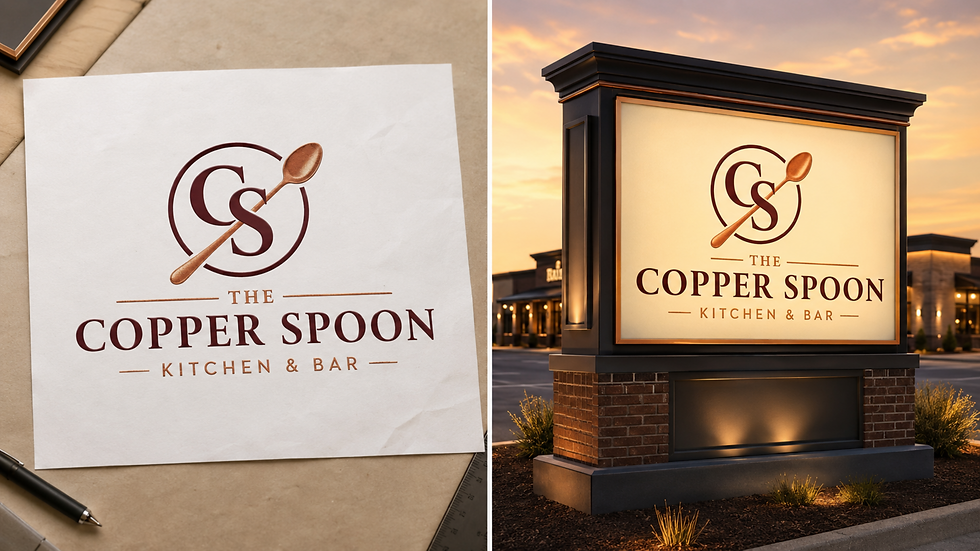
These service areas have their own quirks that a standard design brief doesn't always cover:
Apparel: You don't need to know whether you want screen printing, embroidery, DTF, or vinyl. That's my job. What helps me most is knowing your end goal. How long do you need it to last? What's your budget? What feeling do you want the finished product to give? From there I can recommend the decoration method that actually suits your logo, your garment, and your investment.
Embroidery: If you're thinking about embroidery specifically, the most helpful thing you can tell me is what you love about your logo and what you absolutely can't lose. Fine detail, thin lines, and tiny text behave very differently in thread than they do on screen, and I may need to simplify certain elements to get a clean result. I'll walk you through what that looks like before anything gets stitched.
Signage and Vehicle Decals: For anything going on a wall, window, vehicle, or outdoor space, the most useful details are where it's going and who needs to read it. How far away is the average viewer? Is it indoors or outdoors? What's it mounted on? Sun exposure, viewing distance, and surface all affect what will actually work in the real world. You pick the message and I'll make sure it's built to be seen.
Print: For printed materials like business cards, flyers, brochures, and promotional pieces, the key details are where it's being printed and how it's being distributed. A business card handed person to person works differently than a flyer rack insert or a direct mail piece. Knowing your end goal helps me set up the files correctly the first time so nothing gets lost between your screen and the finished product.
The Bottom Line
Great design is a collaboration, and it works best when both sides know what to expect from each other. Come with a clear brief, the right files, and an agreed set of ground rules, and you'll get better work, faster, with a lot less back and forth.
And when you're not sure what you need? That's what I'm here for. Let's figure it out together.
Ready to get started? Get in touch and let's talk about what you're building.
connect@ashleydesign.ca | www.ashleydesign.ca | (250) 855-8089
C. Ashley Design is an Indigenous-owned graphic design studio based in Williams Lake, BC, offering branding, logo design, print production, embroidery digitizing, and custom embroidery for clients across Canada.


Comments